
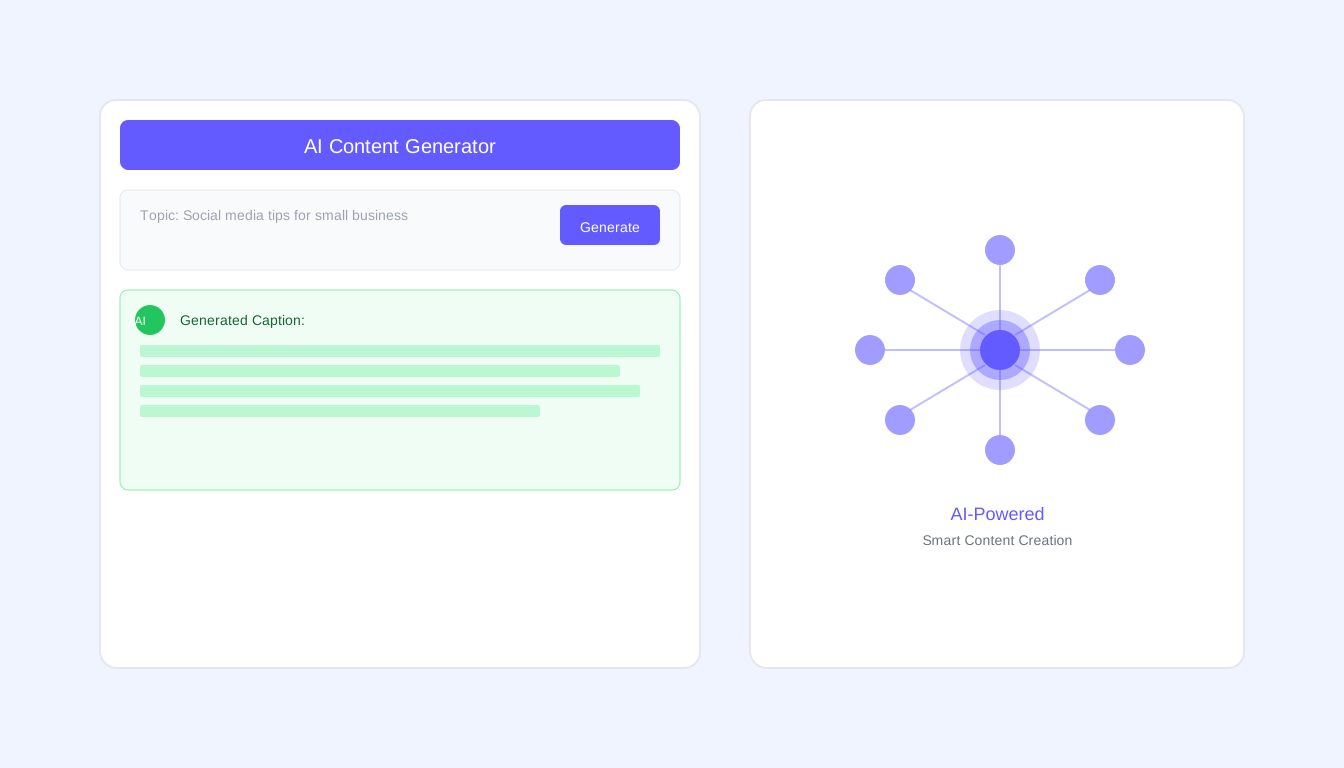
AI isn't coming for social media marketers—it's here to help them. The smartest brands aren't replacing human creativity with AI; they're amplifying it. Here's everything you need to know about AI-powered content creation in 2026.
The State of AI in Social Media
AI has evolved from a novelty to a necessity. Here's where we are:
What AI Can Do Today
- Generate caption variations in seconds
- Analyze top-performing content patterns
- Suggest optimal posting times
- Create images and graphics
- Repurpose long-form content into social posts
- Maintain brand voice consistency at scale
- Predict content performance
What AI Still Can't Do
- Replace genuine human connection
- Navigate sensitive topics with nuance
- Create truly original viral moments
- Understand your business context perfectly
- Respond to real-time events appropriately
The key is knowing when to use AI and when human judgment is essential.
How AI Content Generation Works
Understanding the technology helps you use it better:
Large Language Models (LLMs)
AI writing tools use large language models trained on vast amounts of text. They predict what words should come next based on patterns in their training data.
Fine-Tuning and Prompting
The quality of AI output depends on:
- The underlying model's capabilities
- How well it's fine-tuned for social media
- The prompts and context you provide
Brand Voice Learning
Advanced tools like Pylot analyze your existing content to learn your unique voice, ensuring AI-generated content sounds like you—not generic marketing speak.
AI Use Cases for Social Media
Caption Generation
The most common use case. AI can:
- Generate multiple caption options from a brief
- Adapt tone for different platforms
- Include relevant CTAs and hashtags
- Vary length based on platform best practices
Human role: Select the best option, refine for nuance, add personal touches.
Content Ideation
Stuck for ideas? AI can:
- Suggest topics based on trending conversations
- Generate content calendar themes
- Brainstorm hook variations
- Identify gaps in your content strategy
Human role: Evaluate relevance to your audience, prioritize based on business goals.
Content Repurposing
Transform existing content:
- Blog posts into social threads
- Podcasts into quote graphics
- Videos into text summaries
- Long captions into short-form versions
Human role: Ensure repurposed content makes sense standalone, maintain context.
Hashtag Research
AI can analyze:
- Trending hashtags in your niche
- Hashtag performance patterns
- Optimal hashtag combinations
- Banned or risky hashtags to avoid
Human role: Final selection based on campaign goals and brand fit.
Performance Analysis
AI excels at pattern recognition:
- Identifying what makes your top posts succeed
- Predicting content performance
- Recommending optimization strategies
- Detecting engagement patterns
Human role: Interpret insights, make strategic decisions.
Using AI While Maintaining Authenticity
The biggest fear about AI content: sounding robotic. Here's how to avoid it:
Train AI on Your Voice
Don't use generic AI. Feed it your best-performing content, your brand guidelines, and examples of your ideal tone. Pylot does this automatically by analyzing your existing posts.
Always Edit AI Output
Treat AI content as a first draft, never the final product. Add:
- Personal anecdotes
- Timely references
- Industry-specific nuances
- Your unique perspective
Maintain Human Touchpoints
Some content should always be human-created:
- Responses to sensitive topics
- Crisis communications
- Deeply personal stories
- Real-time engagement
Be Transparent When Appropriate
In some contexts (like thought leadership), your audience expects human-written content. Don't pretend AI-generated content is handcrafted prose.
Building an AI-Assisted Workflow
The 80/20 AI Framework
Use AI for the 80% that's routine; reserve human creativity for the 20% that matters most.
AI handles:
- First drafts of standard posts
- Caption variations
- Hashtag research
- Scheduling optimization
- Basic performance analysis
Humans handle:
- Strategic direction
- Brand voice refinement
- Sensitive content
- Community engagement
- Creative campaigns
The Content Assembly Line
- Brief Creation (Human): Define topic, goal, and key message
- Draft Generation (AI): Create multiple variations
- Refinement (Human): Select, edit, and personalize
- Optimization (AI): Suggest timing, hashtags, formatting
- Review (Human): Final approval
- Publishing (AI): Automated scheduling
- Analysis (AI + Human): Performance review and insights
Batch Processing with AI
Maximize efficiency by batching:
- Generate a week's worth of content ideas at once
- Create multiple variations for each idea
- Review and refine in dedicated editing sessions
- Schedule everything in one sitting
- Monitor performance and feed insights back to AI
AI Content Quality Control
The Hallucination Check
AI can "hallucinate"—generate plausible-sounding but false information. Always verify:
- Statistics and data points
- Quotes and attributions
- Historical references
- Technical claims
The Cringe Test
Read AI content out loud. If it sounds like corporate buzzword soup, rewrite it. Real human writing has rhythm, personality, and imperfection.
The Uniqueness Check
Run AI content through plagiarism checkers. While AI doesn't directly copy, it can produce generic content that closely resembles common phrases.
The Platform Fit Test
AI trained on general web content may not understand platform-specific culture. Review for:
- Appropriate tone
- Correct format conventions
- Platform-specific best practices
- Community expectations
AI Image Generation for Social Media
Text isn't the only AI frontier. Visual content generation is evolving rapidly:
Current Capabilities
- Custom images from text prompts
- Brand-consistent graphics
- Product visualization
- Background removal and editing
- Style transfer and enhancement
Limitations to Know
- Inconsistent results with text in images
- Difficulty with specific brand assets
- Potential copyright concerns
- Quality varies significantly
Best Practices
- Use AI images as starting points
- Always review for brand consistency
- Be cautious with human faces/likenesses
- Combine AI with professional design tools
Choosing AI Tools for Social Media
Integrated Platform Tools
Tools like Pylot build AI directly into the social media workflow — especially powerful for platforms like LinkedIn where consistency drives growth (see our best LinkedIn scheduler comparison for specific tool recommendations):
- Contextual understanding of your platforms
- Brand voice training built-in
- Seamless caption-to-publishing flow
- Platform-specific optimization
Standalone AI Writing Tools
General-purpose tools like ChatGPT or Claude:
- Flexible for various content types
- Require more manual prompting
- No direct social media integration
- Good for ideation and long-form
The Integration Advantage
Purpose-built social media AI tools offer:
- Understanding of platform nuances
- Character count management
- Hashtag optimization
- Performance data integration
- Brand voice consistency
Prompting for Better Results
The Anatomy of a Good Prompt
Context: What's the broader situation? Role: What perspective should AI take? Task: What exactly should it create? Format: How should output be structured? Constraints: What limitations apply? Examples: What does good output look like?
Example Prompts
Basic: "Write a caption for an Instagram post about our new product."
Better: "Write three Instagram caption options for our new product launch. Our brand voice is friendly and professional. Target audience is small business owners. Include a CTA and suggest 5 relevant hashtags. Keep under 2,000 characters."
Best: "You're a social media manager for a B2B SaaS company targeting small business owners. Write three Instagram caption options announcing our new scheduling feature. Tone should be helpful and slightly playful—like a knowledgeable friend, not a corporation. Include a CTA to try free trial. Suggest 5 hashtags with moderate competition. Reference the pain point of inconsistent posting. Format: Hook, value proposition, CTA."
The Future of AI in Social Media
Emerging Capabilities
- Real-time content adaptation based on performance
- Automated A/B testing at scale
- Predictive trend identification
- Personalized content for audience segments
- Video script and editing assistance
What Won't Change
- Need for authentic human connection
- Value of original creative thinking
- Importance of brand differentiation
- Community management requiring empathy
How to Prepare
- Experiment with AI tools now
- Build AI into your workflows gradually
- Focus on skills AI can't replace (strategy, creativity, empathy)
- Stay informed on AI developments
Ethical Considerations
Transparency
Should you disclose AI use? Consider:
- Platform policies on AI content
- Audience expectations
- Content type (ads vs. organic)
- Industry norms
Authenticity
AI should amplify your voice, not replace it. If your feed becomes unrecognizable, you've gone too far.
Job Impact
AI changes roles but doesn't eliminate them. Social media managers become AI directors—guiding tools rather than doing everything manually.
Quality Responsibility
You're responsible for what you publish, regardless of whether AI helped create it. Review everything.
Getting Started with AI Content Creation
Week 1: Experiment
Try AI tools for caption generation. Compare results to your manually written posts.
Week 2: Integrate
Start using AI for first drafts of routine content. Focus on your editing and refinement process.
Week 3: Optimize
Analyze which AI-assisted content performs best. Refine your prompts and workflow.
Week 4: Scale
Expand AI use to more content types. Build systematic processes.
Ongoing
Continuously refine based on results. Stay updated on new capabilities. Maintain the human touch.
Conclusion
AI is the most significant shift in social media marketing since the platforms themselves emerged. But it's not about replacement—it's about augmentation. The best social media content in 2026 combines AI's efficiency and consistency with human creativity and authenticity.
Ready to experience AI-powered content creation? Try Pylot free and discover how AI can transform your social media workflow while keeping your unique voice intact.